Walk through any Balinese village at sunrise and you'll notice something quietly beautiful. Small woven trays of flowers, rice, and curling incense smoke sit on doorsteps, shrine ledges, shop counters, and even street corners. They appear every morning, replaced by fresh ones the next day.
These are Balinese offerings, and they are far more than decoration. For the island's Hindu majority, they are a daily act of gratitude, prayer, and balance. Understanding what they mean can change how you experience Bali, turning a pretty sight into something you can genuinely appreciate and respect.
What Are Daily Balinese Offerings?
The most common daily offering is called canang sari. The name combines two words: canang, a small palm-leaf tray, and sari, meaning essence. Together they suggest a gift of beauty offered with sincere intention.
Canang sari is made fresh each day, usually by women of the household, often before the day's work begins. It is offered to Sang Hyang Widhi Wasa, the supreme god in Balinese Hinduism, and to the many spirits and guardian deities believed to watch over home, land, and community.
There are larger and more elaborate offerings for temple ceremonies and festivals, but canang sari is the heartbeat of daily life. It is simple on purpose, so that it can be made every single day.
What Is Inside a Canang Sari?
Every part of a canang sari has a role. While details vary between families and regions, most include:
The base (ceper): A small square tray woven from young coconut leaf, which holds everything else together.
Porosan: A small bundle of betel leaf, lime, and areca nut, often hidden beneath the petals and linked to the Hindu trinity of Brahma, Vishnu, and Shiva.
Flowers: Colorful petals arranged on top, each color placed with intention.
Rice, food, or small gifts: A symbolic share of the day's sustenance.
Incense: Lit after the offering is set down, carrying prayers upward as the smoke rises.
The effort that goes into making each one is part of the meaning. Offering something handmade, with time and attention, is the point.
The Meaning of the Colors
The flower colors in a canang sari aren't random. Traditionally, they relate to the cardinal directions and the deities who guard them:
White for the east
Red for the south
Yellow for the west
Blue or green for the north
Together, they represent a complete circle of protection and balance. When you see a canang sari, you are often looking at a small map of the universe as understood in Balinese Hindu belief
Tri Hita Karana: The Philosophy Behind the Practice
To understand why offerings happen daily, it helps to know the idea that shapes Balinese life: Tri Hita Karana, often translated as "the three causes of well-being."
It teaches that a good life depends on harmony in three relationships:
Parahyangan: Harmony between people and the divine
Pawongan: Harmony among people
Palemahan: Harmony between people and nature
Daily offerings are a way of keeping these relationships in balance. They express thanks for what has been received, and they are a gentle reminder that human life is connected to something larger. You can read more about the symbolism in this guide to canang sari offerings from The Honeycombers, a respected Bali lifestyle publication.

Where and When Offerings Are Placed
You'll see offerings in different places for different reasons. Those placed at height, on shrines and in family temples, are made for the gods. Those placed on the ground, at gateways and on pavements, are made to acknowledge lower or unseen forces, with the intention of keeping them harmonious rather than disruptive.
Most are placed in the morning, accompanied by a sprinkle of holy water and a brief prayer with incense. Some households make offerings more than once a day. During festivals such as Galungan or Kuningan, the scale of offerings grows dramatically, with towering arrangements of fruit, rice cakes, and flowers.
How to Behave Respectfully Around Offerings
Visitors often wonder how to act around offerings. A few simple habits go a long way:
Step around them, not over them. If you accidentally step on one, a quiet apology is usually understood.
Don't touch or move them. They are sacred to the people who placed them.
Ask before photographing a ceremony. A photo of an offering on the street is generally fine, but be discreet at prayers and temples.
Dress modestly when visiting temples, and follow any guidance from your host or guide.
Remember that you're witnessing living faith, not a performance. Curiosity, offered with humility, is almost always welcomed.
Experiencing Balinese Offerings During Your Stay
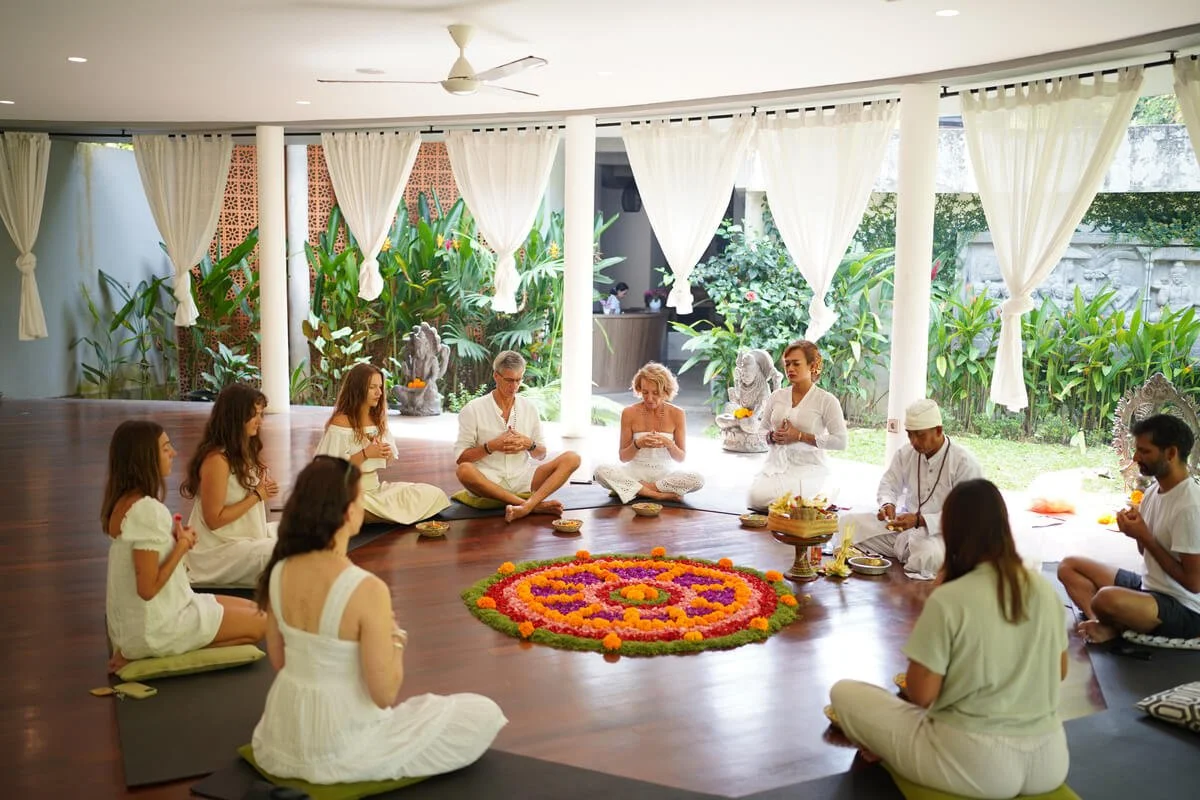
The best way to understand offerings is to take part in the making of one. Many travelers find that sitting down to weave a tray, arrange petals, and learn the meaning behind each element is one of the most memorable cultural experiences of their trip.
At Villa Moksha, guests can join a hands-on Balinese offering workshop, one of several cultural activities designed to help visitors connect with local traditions. Others include Balinese dance classes, village cycling tours, and rice field walks, all set in the quiet countryside near Tanah Lot.
If you're planning a longer stay, a wellness retreat or the property's daily yoga classes can pair beautifully with this kind of cultural immersion. You can also browse the different villa options to find a space that suits your travel style. For a deeper look at the cultural context, this overview of canang sari and its symbolism is a helpful read.
-
Canang sari is the most common daily offering. It is a small palm-leaf tray holding flowers, a porosan bundle, and incense, made fresh each day.
-
Daily offerings express gratitude and help maintain harmony between people, nature, and the divine, in line with the philosophy of Tri Hita Karana.
-
Offerings on the ground are made to acknowledge and appease lower or unseen forces so that they remain in balance. Offerings to the gods are placed higher, on shrines and in temples.
-
It's best to avoid it. Step around offerings where possible. If you step on one by accident, it's not considered a serious offense, and a polite apology is usually enough.
-
Yes. Many resorts and cultural centers in Bali offer guided workshops where visitors learn to make one and understand its meaning.
-
Once the incense has burned and the offering has been presented, the physical items are left to return to nature. Birds, ants, and dogs may eat the food, and the flowers wilt and are swept away the next day.
Final Thoughts
Daily Balinese offerings are small, but they carry a big idea: that gratitude, beauty, and balance belong in everyday life, not just on special occasions. The next time you step carefully around a little tray of petals and smoking incense, you'll know you're looking at something far more meaningful than it first appears.